TCMA · Surry Hills, Sydney · Treatment comparison
FaceTite vs thread lift vs facelift: which approach fits?
Looking after your face is a plan that can evolve with you. At TCMA, we bring together skin care, collagen stimulation and treatments for lifting and tightening, working at different layers to address what matters to you. With thoughtful treatment over time, you may feel happy with your appearance without ever wanting to consider a facelift.
Dr Amy Chahal is specifically trained in minimally invasive and keyhole procedures and performs both FaceTite and thread lifts at TCMA in Surry Hills, Sydney. Both treatments offer more than their initial lifting or tightening effect: collagen stimulation is an important part of their role in a longer-term plan. We look at your skin quality, supporting tissues and facial contours together, then decide what to address and when.
FaceTite uses radiofrequency beneath the skin for tissue tightening and collagen remodelling. Absorbable lifting threads provide lifting support and stimulate collagen around the threads. A surgical facelift repositions tissues and can remove excess skin. These approaches serve different purposes, and your skin still needs its own care whichever path you choose.
Whether you are exploring options before considering surgery, caring for your skin alongside surgery, or would prefer a plan without a facelift, we would love to help. You do not need to know which treatment to book before we meet.
Book a Strategy Session with Dr Amy
Explore your options and build a plan with Dr Amy.
Start with the change you can see
A softer jawline can have several contributors: skin that has become less firm, tissue that has moved downwards, localised fullness or a change in facial volume. More than one can be present. Understanding that combination helps us choose treatments that work towards your particular goals.
In your consultation, we will talk through what you have noticed, what you would like to improve and what each option could offer. Together, we can set priorities and build a plan that feels manageable. There is time to ask questions and decide what feels right for you.
For more on firmness and sagging, explore skin laxity and treatment planning. For the wider background, read how the face ages.
Can a treatment plan help me feel happy without surgery?
For some people, yes. Thoughtful skin care and suitable treatments, planned and reviewed over time, may address enough of what matters to you that you feel happy without ever wanting to consider surgery. That is a valid goal in its own right.
At TCMA, we start with your priorities and look at the different layers contributing to what you see. Treating at multiple layers, where appropriate, is part of Dr Amy’s strategy. Your plan can bring together everyday skin care, treatments for skin quality and collagen stimulation, and procedures for tightening or lifting support. We choose the sequence around your needs, budget and recovery preferences, allowing time to assess the response before deciding on the next step.
The aim is to help you feel comfortable with your appearance and your choices. A staged plan may be enough to meet your goals; significant excess skin or tissue descent may call for a surgical opinion if you want a greater structural change. We will explain the expected benefits and limits of each approach so you can choose with confidence.
Why plan treatment at different layers?

Facial changes can involve the skin’s surface, its collagen-rich supporting layer, underlying fat and the position of facial tissues. Several may contribute to the same concern. A useful plan considers how these features work together.
- Skin surface and daily care: address concerns such as uneven tone, rough texture and dryness, alongside sun protection.
- Skin firmness and supporting tissue: consider suitable treatments that stimulate collagen and tissue remodelling, allowing time for the response to develop.
- Contour and tissue position: assess whether tightening with FaceTite or lifting support from threads would help meet your goals, and how any underlying fullness or volume change affects the choice.
These roles overlap; each treatment is not confined to one neat layer. Dr Amy performs both FaceTite and thread lifts and can explain where either fits within your individual plan. Having several options lets us choose what suits you, rather than expecting one procedure to address every concern.
The sequence matters as much as the choice. We may focus on skin care first, plan a procedure when appropriate, then review your progress before considering anything further. A multilayer approach does not mean everyone needs multiple procedures or that treatments should all happen together.
Do thread lifts and FaceTite stimulate collagen?
Yes. Both can stimulate new collagen, through different mechanisms. This matters when planning beyond the initial lift or tightening: part of the tissue response develops gradually as the area heals and remodels.
With absorbable threads, the tissue response around the placed threads stimulates collagen formation alongside their lifting support. The American Society of Plastic Surgeons describes collagen stimulation as part of how thread lifting works. The thread material, design and placement influence the treatment. How thread lifting works.
FaceTite delivers controlled radiofrequency heating beneath the skin. In addition to tissue contraction, this initiates a healing response involving new collagen formation and remodelling over the following months. An early FaceTite study describes these tissue changes. FaceTite research.
At TCMA, that gradual response is part of planning across different tissue layers. We consider the change you want now, what may develop over time and how to support your skin alongside it. Collagen stimulation does not give everyone the same amount or duration of improvement, so we assess progress rather than assume you need another procedure on a fixed schedule.
For a wider look at treatment mechanisms, read our guide to what actually stimulates collagen.
Firmness is also only one part of skin quality. Pigmentation, surface texture and hydration may benefit from their own care, even when a treatment is stimulating collagen underneath.
Does a facelift improve skin quality?
A facelift addresses sagging and excess skin. It does not, on its own, treat pigmentation, sun damage or rough skin texture, and it does not replace ongoing skin care. Although lifting can improve contours and some folds, the condition of the skin still deserves its own attention. The American Society of Plastic Surgeons distinguishes facelift surgery from treatments directed at skin quality and texture. Facelift information.
Whether you choose surgery or never want it, looking after your skin remains worthwhile. Sun protection, suitable moisturiser and a routine your skin tolerates are useful foundations. Professional treatments may be appropriate for particular concerns, but they are not a requirement for everyone. Everyday skin-care guidance from the American Academy of Dermatology.
If surgery is part of your plan, TCMA can help you consider skin care before and after it, with timing guided by your surgeon and your healing. Tell both clinicians about planned or previous treatments, and get your surgeon’s clearance before resuming active products or procedures around the treated area.
A Complexion Consultation can help you make sense of your skin concerns and home routine. For a broader discussion of skin, facial changes and procedure options, start with a Strategy Session with Dr Amy Chahal.
FaceTite, thread lifting and facelift surgery compared
| Question | FaceTite | Lifting threads | Surgical facelift or neck lift |
|---|---|---|---|
| What is the main approach? | Radiofrequency beneath the skin for contraction and collagen remodelling, with assessment of any localised fullness. | Threads beneath the skin to lift and support selected tissues, with collagen stimulation around absorbable threads. | Surgical repositioning of tissues, with removal of excess skin where indicated. |
| What concern may prompt a discussion? | Selected lower-face or neck laxity, sometimes with localised fullness. | Selected mild tissue descent where a modest change is the goal. | More substantial tissue descent or excess skin, following surgical assessment. |
| How does it fit a longer-term plan? | Tightening and collagen remodelling develop as treated tissue heals. | Mechanical support is complemented by collagen formation around absorbable threads. | Structural repositioning can be complemented by ongoing skin care. |
| Does it remove excess skin? | No. | No. | It can. |
| Does it replace a skin-quality plan? | No. Pigmentation, surface texture and daily skin care need separate consideration. | No. Tissue support does not replace care for skin tone and texture. | No. Lifting and removing excess skin do not replace ongoing skin care. |
| What does recovery involve? | Entry-point care, swelling, bruising and individual activity or compression instructions. | Swelling, bruising, tenderness and specific aftercare instructions. | Incision care, postoperative reviews and a more substantial recovery plan. |
| What should expectations account for? | The amount and type of laxity, fat distribution and individual response. | Thread type, placement, tissue quality and the desired degree of lift; results vary and change over time. | A larger intervention with scars and surgical risks; ageing continues afterwards. |
This is a comparison of approaches, rather than a ranking of which is best. The proposed technique and your examination matter. FaceTite information, thread-lifting information and facelift procedure information explain these distinctions in more detail.
FaceTite at TCMA: tightening and collagen remodelling
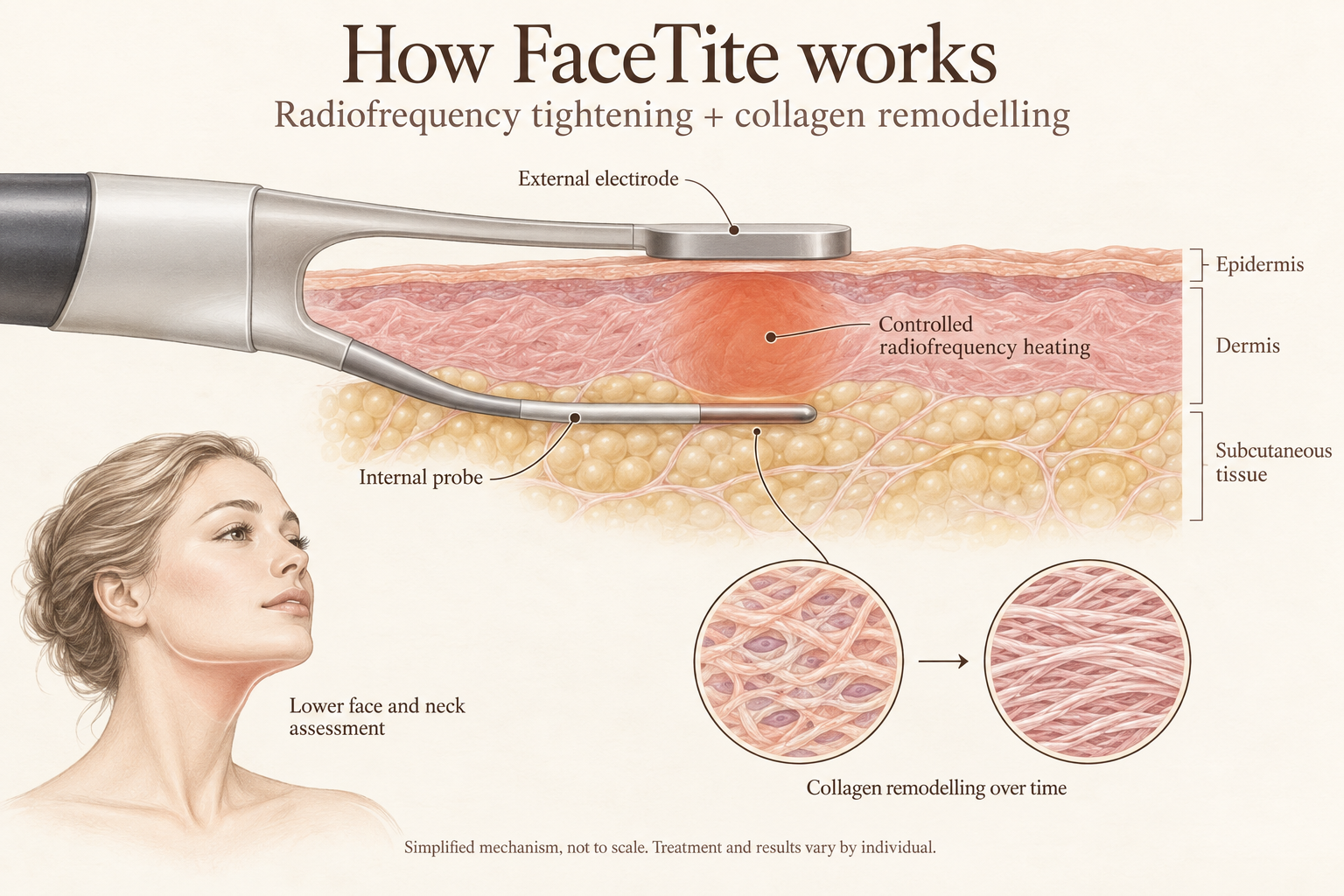
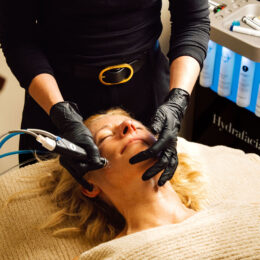
Dr Amy Chahal performs FaceTite to address suitable lower-face and neck concerns. Through small entry points, a probe delivers radiofrequency beneath the skin, combining tissue contraction with a gradual collagen-remodelling response. It may suit someone seeking improved firmness and definition who does not need excess skin removed to achieve their goal.
FaceTite is a minimally invasive procedure that needs planned recovery and aftercare. At your assessment, Dr Amy considers your tissue quality, facial contours and goals, including whether any fat reduction is appropriate. Together, you can consider where it fits within your wider treatment and skin-care plan.
Explore FaceTite at TCMA for procedure, recovery and consultation details, or book a Focused Consultation with Dr Amy to discuss FaceTite.
Thread lifts at TCMA: lifting support and collagen stimulation
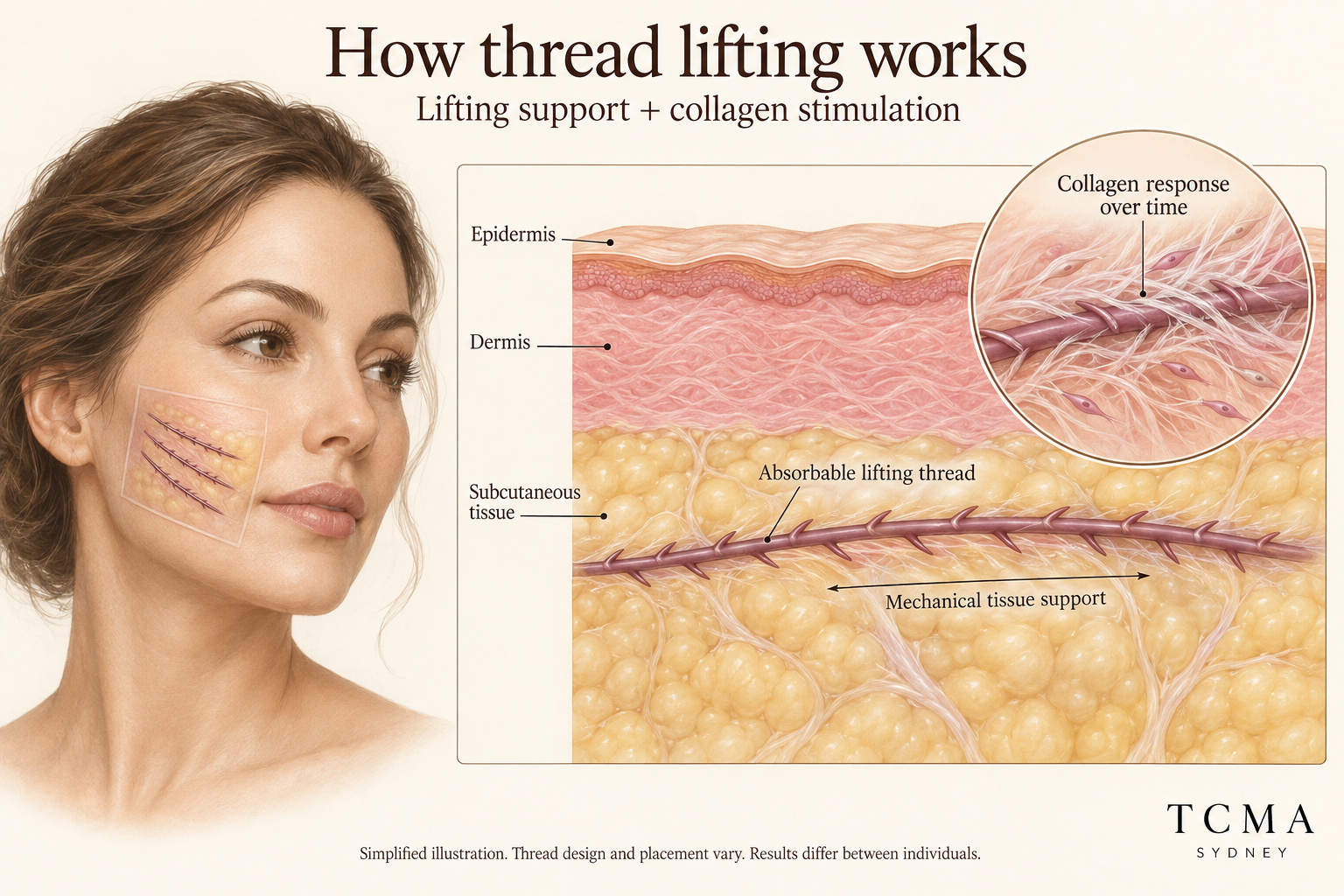
Dr Amy Chahal also performs thread lifts. For suitable patients, lifting threads can improve the position and definition of selected facial tissues without the skin-removal incisions of a facelift. Absorbable threads also stimulate collagen formation around them, making their biological response relevant alongside the initial mechanical lift.
Lifting support and collagen stimulation both matter when we plan thread treatment. Dr Amy assesses your anatomy and skin quality, explains the proposed threads and placement, and considers how they could complement care at other layers. Your plan is tailored to your goals, with time for healing, collagen development and review before deciding on any further treatment.
Explore thread lifts at TCMA, or book a Focused Consultation with Dr Amy to discuss thread lifting.
When a surgical opinion is useful
If substantial excess skin or deeper tissue descent is driving the concern, a surgical opinion can help establish what would be required to achieve your goal. Facelift and neck-lift techniques differ in their extent and the structures they address. The surgeon should explain the proposed operation, incision placement and expected limits. How facelift surgery is performed.
You do not have to try a smaller procedure before seeking that opinion. Knowing the surgical options may help you decide to proceed, postpone treatment or accept a more modest change.
Planning your recovery and aftercare
Being comfortable working from home, returning to exercise and feeling ready for an important event are different recovery milestones. Ask about each separately, including the possibility that swelling or another complication could extend the timeline.
For FaceTite and related procedures that deliver radiofrequency beneath the skin, possible problems include prolonged swelling or altered sensation, firmness or nodules, burns and nerve-related symptoms. Read the review.
For thread lifting, discuss bruising, swelling, pain, infection and threads becoming exposed or requiring treatment. Initial recovery can involve discomfort and specific care of the entry points. Thread-lift risks and recovery guidance.
Facelift surgery has its own risks, including bleeding, infection, wound-healing problems, scarring, altered sensation and facial nerve injury. Anaesthesia and your health history are also part of the assessment. Facelift risks and safety.
Discuss your previous procedures, medicines and healing history with the treating clinician. Ask who you should contact if recovery is not progressing as expected.
How long will the results last?
With FaceTite and absorbable thread lifting, the early change and the later collagen response are different parts of the treatment journey. Allowing time for healing and remodelling gives a more useful picture than judging the result immediately after a procedure.
How long you remain happy with the result depends on the treatment, your starting point, your response and ongoing ageing. At follow-up, we can review your progress across the concerns we are treating and discuss whether skin care, maintenance or simply allowing more time makes sense. A long-term plan does not have to mean frequent procedures.
Published studies use different techniques and follow-up periods. Some assess FaceTite alongside other procedures, and long-term data for absorbable thread lifting remain limited. This is why we avoid promising a fixed lifespan or assuming collagen stimulation guarantees a lasting lift. Combined FaceTite study and thread-lift review.
Questions to bring to your consultation
- Is my main concern skin quality, skin laxity, tissue descent, fullness, volume loss or a combination?
- Could a staged plan meet my goals without surgery, and how will we decide when enough is enough?
- What change is realistic, and what would this procedure leave unchanged?
- Would a surgical opinion help before I commit to treatment?
- What should I allow for work, exercise and social recovery?
- What is included in the total fee, aftercare and follow-up?
- How would we assess the result, and what would happen if I was unhappy with it?
Comparing costs means comparing the whole plan. Ask about the proposed treatment area, anaesthesia, any facility costs, follow-up and the possibility of further treatment. Current TCMA consultation information is available on the consultations page; individual procedure fees need to relate to the plan proposed for you.
Published 25 September 2026 · TCMA